Showing posts with label Top 10 Space News. Show all posts

Monday, February 28

Top 10 Best Pictures From International Space Station

Top 10 Pictures from International Space Station

Discovery approaches for docking@ International Space Station

image


Chile's From International Space Station

image


Necochea, Argentina From International Space Station

image


Cyclone Dianne forms off the northwest coast of Australia

image


Bahia Anegada, Argentina

image


Madrid, Spain

image


Moonrise View From International Space Station

image


The giant is awakened! Sicily and Mount Etna

image


Desert, Somalia

image


The Switzerland of the Middle East.

image


Source: Flicker

Tuesday, February 9

Top 10 Astronomy Picture

1: That First Small Step

That First Small Step That shiny white thing in the upper left where humans first slipped the surly bonds of Earth, and walked on another world.

2: The Detail’s in the DevilThe Detail’s in the Devil Mars has an atmosphere, though it’s thin: about 1% of Earth’s atmospheric pressure, it doesn’t seem capable of doing much. But when you have a robotic probe like the Mars Reconnaissance Orbiter and its 50-cm resolution orbiting the Red Planet, you see far, far more, and learn that the air of Mars can create beauty.The image above shows a region of Mars near its mid-lower northern latitudes. It’s a close-up of the bed of a crater, and you can see the ripples of sand dunes, endemic on the Martian surface. The sand is similar to beach sand here on Earth, but is dark in color because it’s made of basalt, a greyish rock. Then why is Mars so red? It’s because of much finer-grain dust, which is reddish in hue. The dust lies on top of the sand, making everything look red

3: Eternally StargazingEternally Stargazing The skies there must be incredibly dark; located about 3000 km west of Chile in the Pacific Ocean, you might wonder how much more black the nights could be, and of course the answer is none.

4: Hubble’s MetamorphosisHubble’s Metamorphosis In May 2009, the Space Shuttle Atlantis roared into orbit to rendezvous with the ailing Hubble Space Telescope. After several exciting spacewalks, astronauts succeeded in making many upgrades to the venerable observatory, including installing new high-resolution cameras, fixing old shorted-out cameras, and replacing needed hardware like computer parts and gyroscopes. We all waited anxiously, and finally, in September, new images from the refurbished ’scope were released

5: Beautiful plumageBeautiful plumage!

The Cassini spacecraft has been orbiting Saturn since 2004, and has been returning a virtual firehose of incredible images and science ever since. I’d argue it’s one of the most dramatically successful space probes of all time. It’s certainly revolutionized our view of the ringed planet over and again

6: The Cosmic Hand of DestructionCosmic Hand of Destruction This eerie shot, from the Chandra X-ray Observatory, is actually showing extremely hot gas around a pulsar, the rapidly spinning core of a once-exploded star. The pulsar — named PSR B1509-58 — is buried in the bright spot in the "wrist" of this structure. As the pulsar spins, it generates extremely strong magnetic winds which blow out and interact with previously existing gas in the region. Dense knots of gas form, and those are at the tips of the "fingers" (if only they were holding a "laser"). The red gas above is probably expanding material from the supernova explosion that formed the pulsar in the first place, something like 1700 years ago.

7: The Lunar abyss stares backThe Lunar abyss stares back One of the biggest news stories of the year was the confirmation of large quantities of water on the Moon, stored in the endless dark of crater floors at the lunar poles. If the crater is deep enough sunlight can never reach the bottom, and the temperature stays chillingly cold. Water can come in the form of comets, for example, which impact the Moon and blast water molecules over the surface. When sunlight hits them the molecules quickly fall apart, forming hydrogen and hydroxyl ions. But if the water settles to the floor of a polar crater, it can stay intact. Over billions of years, it builds up.

8: Earth from spaceEarth from space

In November 2009, Rosetta swung by the Earth for its third and final assist. While it was still over 600,000 km (360,000 miles) away, it took this remarkable image of our home.

9: A Computer’s Spot in the Sun

Computer’s Spot in the Sun30 Dark blemishes on the Sun have been known since antiquity; when the setting Sun’s disk is dimmed by dust in the air, you can sometimes see sunspots against its reddened face. Those are monster spots, and very rare, but even the normal run-of-the-mill sunspots aren’t well understood.

10: Pandora’s Galaxy

Pandora’s GalaxyNGC 4522 is a spiral galaxy that lies 60 million light years away, a denizen of the Virgo Cluster, the nearest such collection of galaxies to our Milky Way.(Thanks )

Saturday, December 27

TOP -10 Most Viewed Space Photos of 2008-2009

1. Venus, Jupiter, Moon Smile on Earth
The heavens smiled down on Earth December 1 in National Geographic News's most viewed space photo of 2008. The celestial smiley face is the result of a planetary conjunction between Venus, Jupiter, and the moon, shown here over Manila in the Philippines.People in Asia saw the smile while sky-watchers in the United States saw a frown, though we're sure it was nothing personal.

10_toptenspace_461

2. First Mars Avalanches Seen In Action
NASA scientists might have been yodeling for joy in March when they saw the first-ever picture of active landslides occurring on Mars.Snapped by the Mars-orbiting HiRISE camera, billowing clouds of dust revealed the action at the base of a towering slope near the red planet's north pole. "It's great to see something so dynamic on Mars," HiRISE team member Ingrid Daubar Spitale noted at the time. "A lot of what we see there hasn't changed for millions of years." (Read an essay on Mars by famed author Ray Bradbury from this year's special space issue of National Geographic magazine.)

9_toptenspace_461

3. Gamma-Ray Burst Visible to Naked Eye
In March scientists detected an interstellar explosion so bright that it was briefly visible to the naked eye—from 7.5 billion light-years away.Images captured by NASA's Swift satellite show two views of the unusual gamma-ray burst, an outpouring of high-energy radiation and particles thought to follow the collapse of a massive star.The burst crushed the previous record holder for most distant object visible without assistance—the galaxy M33—by three orders of magnitude.

8_toptenspace_461

4.NEW JUPITER :Sharpest View Ever From Earth
Jupiter looks sharp in the crispest whole-planet picture of the gas giant ever shot from Earth, released in October.The picture was taken using a computer-assisted process that adjusts for distortions caused by Earth's atmosphere, allowing a ground-based telescope in Chile to snap shots rivaling those taken from space, astronomers said.In Jupiter's case, the result shows features as small as 180 miles (300 kilometers) across.

7_toptenspace_461

5. New Hi-Res Views of Mars's ''Fear'' Moon Unveiled
In April the Mars-orbiting HiRISE camera caught new high-resolution snapshots of Phobos, a Martian moon named for the Greek god of horror.The tiny moon's most prominent feature is Stickney Crater, pictured above in false color. The impact that created Stickney is thought to have almost shattered the roughly 17-mile-wide (27-kilometer-wide) moon. (Find out how Stickney Crater is revealing new insights into Phobos's makeup at the National Geographic News space blog, Breaking Orbit.)

6_toptenspace_461

6. New Picture of the Pinwheel Galaxy
An image released by NASA in April shows baby stars taking shape in the Southern Pinwheel galaxy.Embryonic stars were found to be growing in the galaxy's spindly arms (shown in red), rather than in its bright heart.Scientists at the time described the find as "absolutely stunning," because it was believed that such outlying sections of galaxies lacked the necessary materials for star formation

5_toptenspace_461

7. New Supernova "Gumball" Picture
The remnant of a supernova, first seen from Earth more than a thousand years ago, hangs like a gumball in a composite image released by NASA in June.The blast wave from the stellar explosion is still traveling at about 6 million miles (9.6 million kilometers) an hour, heating gases along its path that emit radiation as visible light.

4_toptenspace_461

8. Black Hole Seen in Closest Look Ever
Ground-based radio telescopes in Hawaii, Arizona, and California combined forces to examine the super massive black hole at the center of the Milky Way.Although by definition we can't see a black hole directly, we can see the bright region of radio emissions known as Sagittarius A* that's thought to be either a disk of matter swirling toward the black hole, or a high-speed jet of matter being ejected from it.Astronomers who released the image in September noted that further study of Sagittarius A* should help us understand "what happens as matter is drawn near to the black hole and disappears forever."

3_toptenspace_461

9. First Picture of Alien Planet Orbiting Sunlike Star?
A faint dot above a blazing inferno is possibly the first direct view of a planet outside our solar system orbiting a sunlike star.The infrared image, taken by the Gemini Observatory in Hawaii, was released in September. At the time astronomers weren't sure whether the body was a planet or a planet like object, and it remains to be seen if it is truly orbiting the star.Two months later independent teams announced the first infrared image of an alien multiplanet system, taken using a pair of ground-based telescopes, as well as the first visible-light picture of an extra solar planet, snapped by the Hubble Space Telescope.

2_toptenspace_461

10. Supernova Creates "Ribbon" in Space
Like a ribbon trailing from a parade float, a streamer of hydrogen gas seems to waft across the stars in an image taken by the Hubble Space Telescope.Released in July, this festive shot of a supernova remnant was National Geographic News's tenth most viewed space photo of 2008.Bright stripes within the ribbon—which is actually the shock wave from the stellar explosion—appear where the wave is moving edge-on to Hubble's line of sight.

1_toptenspace_461

Thursday, October 2

Top-10 Hubble Telescope's space photographs.

Hubble Telescope's top ten greatest space photographs.

Awesome!!!

 Hubble Telescope's space photographs
The Sombrero Galaxy - 28 million light years from Earth - was voted best picture taken by the Hubble telescope. The dimensions of the galaxy, officially called M104, are as spectacular as its appearance. It has 800 billion suns and is 50,000 light years across.

 Hubble Telescope's space photographs
The Ant Nebula, a cloud of dust and gas whose technical name is Mz3, resembles an ant when observed using ground-based telescopes...

The nebula lies within our galaxy between 3,000 and 6,000 light years from Earth.

 Hubble Telescope's space photographs

In third place is Nebula NGC 2392, called 'Eskimo' because it looks like a face surrounded by a furry hood. The hood is, in fact, a ring of comet-shaped objects flying away from a dying star. Eskimo is 5,000 light years from Earth.

 Hubble Telescope's space photographs
At four is the Cat's Eye Nebula.

 Hubble Telescope's space photographs
The Hourglass Nebula, 8,000 light years away, has a 'pinched-in- the-middle' look because the winds that shape it are weaker at the centre.

 Hubble Telescope's space photographs
In sixth place is the Cone Nebula. The part pictured here is 2.5 light years in length (the equivalent of 23 million return trips to the Moon).

 Hubble Telescope's space photographs The Perfect Storm, a small region in the Swan Nebula, 5,500 light years away, described as 'a bubbly ocean of hydrogen and small amounts of oxygen, sulphur and other elements'.

 Hubble Telescope's space photographs
Starry Night, so named because it reminded astronomers of the Van Gogh painting. It is a halo of light around a star in the Milky Way.

 Hubble Telescope's space photographs
The glowering eyes from 114 million light years away are the swirling cores of two merging galaxies called NGC 2207 and IC 2163 in the distant Canis Major constellation.

 Hubble Telescope's space photographs

Friday, March 14

Top 10 Facts about Milky Way Galaxy

So you’ve lived here all your life — in fact, everyone has — but what do you really know about the Milky Way galaxy? Sure, you know it’s a spiral, and it’s 100,000 light years across. Learn a lot more from here as i have presented only the essential things about the Milky Way Galalxy.

So let’s see if these really are Ten Things You Don’t Know About the Milky Way Galaxy.

1) It’s a barred spiral.

Milkyway_1

You might know that the Milky Way is a spiral galaxy, perhaps the most beautiful galaxy type. But you can know lot about them. They have a majestic arms sweeping out from a central hub or bulge of glowing stars. A lot of spirals have a weird feature: a rectangular block of stars at the center instead of a sphere, and the arms radiate away from the ends of the block. Astronomers call this block a bar, and, we have one.

In fact, ours is pretty big. At 27,000 light years end-to-end, it’s beefier than most bars. Of course, space is a rough neighborhood.


2) There’s a supermassive black hole at its heart.

At the very center of the Galaxy, right at its very core, lies a monster: a supermassive black hole. We know it’s there due to the effect of its gravity. Stars very near the center — some only a few dozen billion kilometers out — orbit the center at fantastic speeds. They scream around their orbits at thousands of kilometers per second, and their phenomenal speed betrays the mass of the object to which they’re enthralled. Applying some fairly basic math, it’s possible to determine that the mass needed to accelerate the stars to those speeds must tip the cosmic scales at four million times the mass of the Sun! Yet in the images, nothing can be seen. So what can be as massive as 4,000,000 Suns and yet not emit any light?

Right. A black hole.

Even though it’s huge, bear in mind that the Galaxy itself is something like 200 billion solar masses strong, so in reality the black hole at the center is only a tiny fraction of the total mass of the Galaxy. And we’re in no danger of plunging into it: after all, it’s 250,000,000,000,000,000 kilometers away.

It’s thought now that a supermassive black hole in the center of a galaxy forms along with the galaxy itself, and in facts winds blown outward as material falls in affects the formation of stars in the galaxy. So black holes may be dangerous, but it’s entirely possible the Sun’s eventual birth — and the Earth’s along with it — may have been lent a hand by the four million solar mass killer so far away.


3) It’s a cannibal.

Galaxies are big, and have lots of mass. If another, smaller galaxy passes too close by, the bigger galaxy can rip it to shreds and ingest its stars and gas.Milkyway_2

The Milky Way is pretty, but it’s savage, too. It’s currently eating several other galaxies. They’ve been ripped into long, curving arcs of stars that orbit the center of the Milky Way. Eventually they’ll merge completely with us, and we’ll be a slightly larger galaxy. Ironically though, the galaxies add their mass to ours, making it more likely we’ll feed again. Eating only makes galaxies hungrier.


4) We live in a nice neighborhood…

The Milky Way is not alone in space. We’re part of a small group of nearby galaxies called — get ready to be shocked — the Local Group. We’re the heaviest guy on the block, and the Andromeda galaxy is maybe a bit less massive, though it’s actually spread out more. The Triangulum galaxy is also a spiral, but not terribly big, and there are other assorted galaxies dotted here and there in the Group. All together, there are something like three dozen galaxies in the Local Group, with most being dinky dwarf galaxies that are incredibly faint and difficult to detect.


5) … and we’re in the suburbs.

The Local Group is small and cozy, and everyone makes sure their lawns are mowed and houses painted nicely. That’s because if you take the long view, we live in the suburbs. The big city in this picture is the Virgo Cluster, a huge collection of about 2000 galaxies, many of which are as large or larger than the Milky Way. It’s the nearest big cluster; the center of it is about 60 million light years away. We appear to be gravitationally bound to it; in other words, we’re a part of it, just far-flung. The total mass of the cluster may be as high as a quadrillion times the mass of the Sun.


6) You can only see 0.000003% percent of it.

When you got out on a dark night, you can see thousands of stars. But the Milky Way has two hundred billion stars in it. You’re only seeing a tiny tiny fraction of the number of stars tooling around the galaxy. In fact, with only a handful of exceptions, the most distant stars you can readily see are 1000 light years away. Worse, most stars are so faint that they are invisible much closer than that; the Sun is too dim to see from farther than about 60 light years away… and the Sun is pretty bright compared to most stars. So the little bubble of stars we can see around us is just a drop in the ocean of the Milky Way.


7) 90% of it is invisible.

When you look at the motions of the stars in our galaxy, you can apply some math and physics and determine how much mass the galaxy has (more mass means more gravity, which means stars will move faster under its influence). You can also count up the number of stars in the galaxy and figure out how much mass they have. Problem is, the two numbers don’t match: stars (and other visible things like gas and dust) make up only 10% of the mass of the galaxy. Where’s the other 90%?

Milkyway_2

Whatever it is, it has mass, but doesn’t glow. So we call it Dark Matter, for lack of a better term (and it’s actually pretty accurate). We know it’s not black holes, dead stars, ejected planets, cold gas — those have all been searched for, and marked off the list — and the candidates that remain get pretty weird (like WIMPs). But we know it’s real, and we know it’s out there. We just don’t know what it is. Smart people are trying to figure that out, and given the findings in recent years, I bet we’re less than a decade from their success.


8) Spiral arms are an illusion.

Well, they’re not an illusion per se, but the number of stars in the spiral arms of our galaxy isn’t really very different than the number between the arms! The arms are like cosmic traffic jams, regions where the local density is enhanced. Like a traffic jam on a highway, cars enter and leave the jam, but the jam itself stays. The arms have stars entering and leaving, but the arms themselves persist (that’s why they don’t wind up like twine on a spindle).

Just like on highways, too, there are fender benders. Giant gas clouds can collide in the arms, which makes them collapse and form stars. The vast majority of these stars are faint, low mass, and very long-lived, so they eventually wander out of the arms. But some rare stars are very massive, hot, and bright, and they illuminate the surrounding gas. These stars don’t live very long, and they die (bang!) before they can move out of the arms. Since the gas clouds in the arms light up this way, it makes the spiral arms more obvious.

We see the arms because the light is better there, not because that’s where all the stars are.


9) It’s seriously warped.

The Milky Way is a flat disk roughly 100,000 light years across and a few thousand light years thick (depending on how you measure it). It has the same proportion as a stack of four DVDs, if that helps.

Have you ever left a DVD out in the Sun? It can warp as it heats up, getting twisted (old vinyl LPs used to be very prone to this). The Milky Way has a similar warp!

The disk is bent, warped, probably due to the gravitational influence of a pair of orbiting satellite galaxies. One side of the disk is bent up, if you will, and the other down. In a sense, it’s like a ripple in the plane of the Milky Way. It’s not hard to spot in other galaxies; grab an image of the Andromeda galaxy and take a look. At first it’s hard to see, but if you cover the inner part you’ll suddenly notice the disk is flared up on the left and down on the right.Milkyway_4

Andromeda has satellite galaxies too, and they warp its disk just like our satellite galaxies warp ours.

As far as I can tell, the warp doesn’t really affect us at all. It’s just a cool thing you may not know about the Milky Way. Hey, that would make a good blog entry!


10) We’re going to get to know the Andromeda galaxy a lot better.

Speaking of Andromeda, have you ever seen it in the sky? It’s visible to the naked eye on a clear, dark, moonless night (check your local listings). It’s faint, but big; it’s four or more degrees across, eight times the apparent size of the Moon on the sky.

If that doesn’t seem too big, then give it, oh, say, two billion years. Then you’ll have a much better view.

The Andromeda Galaxy and the Milky Way are approaching each other, two cosmic steam engines chugging down the tracks at each other at 200 kilometers per second. Remember when I said big galaxies eat small ones? Well, when two big galaxies smack into each other, you get real fireworks. Stars don’t physically collide; they’re way too small on this scale. But gas clouds can, and like I said before, when they do they form stars. So you get a burst of star formation, lighting up the two galaxies.Milkyway_5

In the meantime, the mutual gravity of the two galaxies draw out long tendrils from the other, making weird, delicate arcs and filaments of stars and gas. It’s beautiful, really, but it indicates violence on an epic scale.

Eventually (it takes a few billion years), the two galaxies will merge, and will become, what, Milkomeda? Andromeway? Well, whatever, they form a giant elliptical galaxy when they finally settle down. In fact, the Sun will still be around when this happens; it won’t have yet become a red giant. Will our descendants witness the biggest collision in the history of the galaxy?

That’s cool to think about. Incidentally, I talk about this event a whole lot more, and in a lot more detail, in my upcoming book Death from the Skies! In case you forgot about that.

Until then, these Ten Things should keep you occupied. And of course, I only wanted to list ten things so I could give this post the cool title. But if you still wanna find more interesting facts about the Milky Way visit badastronomy site.


Friday, December 14

Top 10 Astronomy Pictures of 2007

Top 10 Astronomy Pictures for 2007 (source: bad astronomy )

Number 10: A Comet Bursts Forth

People all over the world took pictures of the comet’s outburst (the cause of which is still something of a mystery).

Astronomy Picture-1

This picture was taken on November 29, 2007 by the gifted astrophotographer Tamas Ladanyi This remarkable shot covers several degrees of sky.

Comet Holmes is still fading away. But will it brighten again? In 1892, just after it was first discovered, Holmes had an outburst very similar to this modern one. So even as it dims and moves into the outer solar system, is it gearing up for another exciting run?

Number 9: A Black Hole on Mars

What is it about Mars that draws us in? Even through a big telescope it’s small, distant, and fuzzy. But when you gaze up on it in the night sky it’s a bright bloody beacon, a glaring eye staring back at you. No wonder the ancients thought it the god of war!

Astronomy Picture-2

The picture shows a pit crater, a collapsed shaft going down into the surface of Mars. It’s on the side of a volcano. Most likely they form when magma under the surface subsides, and the ground above it collapses.

Number 8: The Wonderful

The red giant star Mira is called "The Wonderful" because it brightens and dims noticeably to the naked eye, sometimes going from quite bright to total invisibility in just a few weeks. Mira is a star on its death bed; it is in the final stages of sloughing off its outer layers, and in a few hundred thousand years the entire envelope of the star will have been ejected, leaving only a naked and very hot white dwarf star.

Astronomy Picture-3

Mira is like a comet! But a lot, lot bigger: the tail of Mira is 13 light years (130 trillion kilometers/80 trillion miles) long.

The tail is really the gas ejected by the star as it dies. As Mira moves through space, the gas between the stars slows the ejected material, forming the long streamer. In the picture, the motion is left to right, so the left-hand side of the tail is the oldest. On the right you can actually see the bow shock as the star plows through the gas between stars.

Mira is much like the way the Sun will be in a few billion years when its time runs out, for one, so by studying this image we are perhaps peering into our own future. But it also tells us that even a familiar object can surprise us, when we look at it with different eyes.

Number 7: The Lover’s Embrace of Arp 87

Galaxies seem like immutable giants of the cosmos; serene, majestic, and unmoving. But that’s an illusion. Everything in space is in motion, including galaxies. As you can imagine, when you take a collection of several hundred billion stars and set it in motion, it can be pretty hard to stop it. Galaxies move through space at numbing speeds, and the forces built up are mighty.

But then, sometimes, another galaxy gets in the way.

Then those vast forces come into play. Gravity twists and pulls at the galaxies as they dance past each other. And, as if they resist the inevitable recession of their partner, they reach out to one another in what looks like a tender embrace, but is in reality a stark (if lovely) portent of the destruction wrought on both galaxies.

Astronomy Picture-4

Arp 87 is the name given to the system of two galaxies, NGC 3808A and NGC 3808B. They passed each other just as the age of dinosaurs was starting to get going on Earth, 200 million years ago.

We can see reddish gas clouds collapsing to form stars in the galaxies, and we can (just barely) tell that NGC 3808B is looking a little disturbed. Will the two galaxies continue to separate, or will gravity eventually win, drawing them together? Perhaps the latter. In a few hundred million years the merged remnant will settle down and look like a normal galaxy once again. And while this may look like a totally alien tableau, keep in mind that the Milky Way Galaxy has suffered through such collisions in the past… and will again: the Andromeda Galaxy is bearing down on us. In a couple of billion years, the fireworks here will begin.


Number 6: Lightning at Weikerscheim Observatory

Astronomy only plays a tangential role in this picture… you can see stars in the sky, and the observatory is pretty obvious. But it’s the terrestrial drama that steals the show.

Astronomy Picture-5

Jens Hackmann took this stunning picture of a lightning storm near the Weikerscheim Observatory; the 300 second exposure is enough to see the stars streak and the observatory lit up by ambient light. Sometimes, when it’s cloudy, observing is difficult… but you can still get incredible pictures.

Number 5: A Meeting of the Moons

Jupiter is fantastically massive, and the most interesting of its family are the moons Europa and Io.

Europa is an ice world, covered in a thick sheet of ice that might reach down to depths of over perhaps several kilometers. It’s nearly a dead certainty that underneath that forbidding icecap is an ocean of water, kept liquid from energy input by gravitational stress as Europa passes by her sister moons. Of all the real estate in the solar system, many astronomers have their money on Europa as the best place to look for alien life.

Io, on the other hand, is perhaps the worst place for life. It has an incredibly high sulfur content, for one thing. For another, the same gravitational heating that keeps Europa’s ocean liquid also keeps Io’s interior molten, but it gives the moon a cosmic case of indigestion.

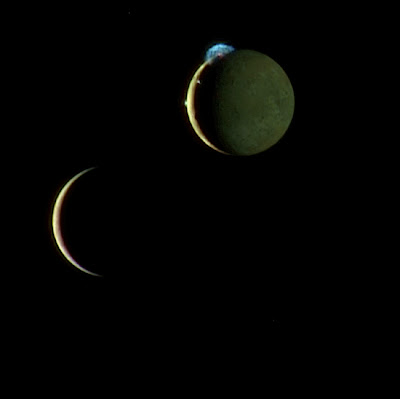
Io is wracked with volcanoes. They are almost constantly erupting molten sulfur over a kilometer high in the low gravity, and plumes of dust and gas blast hundreds of kilometers off the surface. This activity was first discovered when the Voyager 1 probe passed the moon in 1979, but subsequent space probes have gotten even more detailed images. When the New Horizons Pluto probe passed Jupiter in March 2007 for a gravity boost, it snapped a beautiful picture of the sisters.

Astronomy Picture-6

Europa is the crescent on the lower left, and Io (obviously) is the one on the upper right. The plume you see is from the volcano Tvashtar, which has been active for quite some time now. If you look right at the bottom of the plume, you can see molten sulfur glowing red. Two other volcanoes appear to be making some noise as well.

While they appear to be close together, the two moons were actually nearly 800,000 kilometers apart when this picture was taken; Io was on one side of Jupiter and Europa on the other, but from the spacecraft’s perspective they were next to each other in the sky.

Number 4: Dark Matter Makes an Appearance

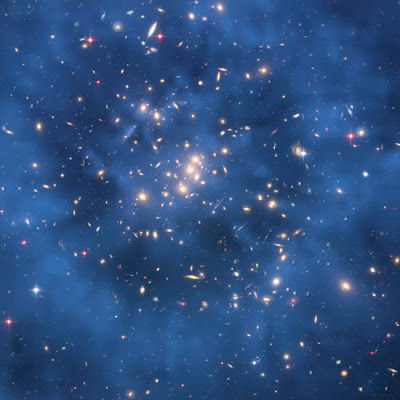
The gravity of dark matter has a subtle effect: it acts like a lens, bending the path of light coming from objects behind it.

Astronomy Picture-7

In this Hubble image, the white dots are entire galaxies. They are part of a cluster called CL0024+1652, which is a whopping 5 billion light years away. The blue glow is the location of the dark matter, revealed by its distortion of the shapes of more distant galaxies behind it. The dark matter is in the shape of a ring surrounding the cluster, which indicates that a long time ago, CL0024 suffered a mighty blow, colliding head-on with another cluster. The dark matter from the two clusters passed right through each other, and their gravity caused the material to form the ring shape. We’re seeing this right down the barrel of the collision.

This image is a stunning confirmation of the existence of dark matter, and our understanding of how it works. Many people — who don’t understand the science — claim dark matter doesn’t exist, and that astronomers are making it all up. Well, there’s a giant smoke ring in the sky indicating they are quite wrong.

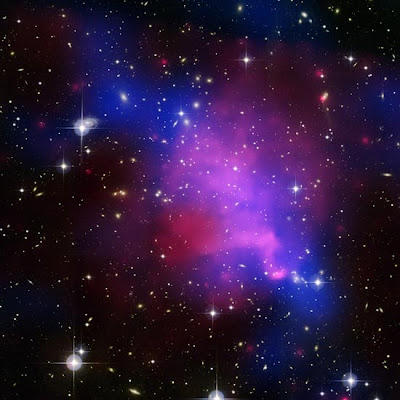
Astronomy Picture-8

In this image red is normal matter heated to millions of degrees, and blue shows the location of the dark matter.

Number 3: Chaos in Vela

Astronomy Picture-9

This image shows the devastation wrought when a star explodes. The Vela Supernova Remnant formed when a massive star 800 light years away blew up 11,000 years ago. Expanding at a ferocious velocity, it is now 8 degrees across in the sky — 16 times the apparent width of the Moon, and about the size of your outstretched fist!

Number 2: STEREO Eclipse

Studying the Sun seems like a pretty good idea; as the major source of light and heat for our planet, it’s a good thing that we try to understand it. And the Sun is a star, with all that implies: it’s huge in size, and frightening in its energy production.

To better understand it and the complicated nature of its surface activity, NASA launched a pair of satellites that can take pictures of the Sun simultaneously from different angles, providing a 3D view of our nearest star. They’re called the Solar Terrestrial Relations Observatory, or STEREO.

This sequence shows something we can never see from the Earth: a shrunken Moon passing in front of the Sun. Technically, it’s not even really an eclipse; it’s a transit (when something small crosses in front of something large). That video, only 8 seconds long, is incredible.

And the Number One Astronomy Picture of 2007 is…

The Beautiful Face of IC 342

They are sweeping, majestic, chillingly beautiful, and utterly mesmerizing. There are many such grand design spirals in the sky, and astronomers are almost all familiar with the roster: M81, M51, M101, and others. But there is one that is a bit less seen, less well known. That’s because it hides itself, tucked away in a part of the sky where stars and dust are thick, obscured by the fog of our own Galaxy.

Astronomy Picture-10

This creature is IC 342, a nearby spiral lying only 11 million light years away, very close on a galactic scale.

Older Post ►
 

Copyright 2011 Top 10 is proudly powered by blogger.com | Design by BLog BamZ